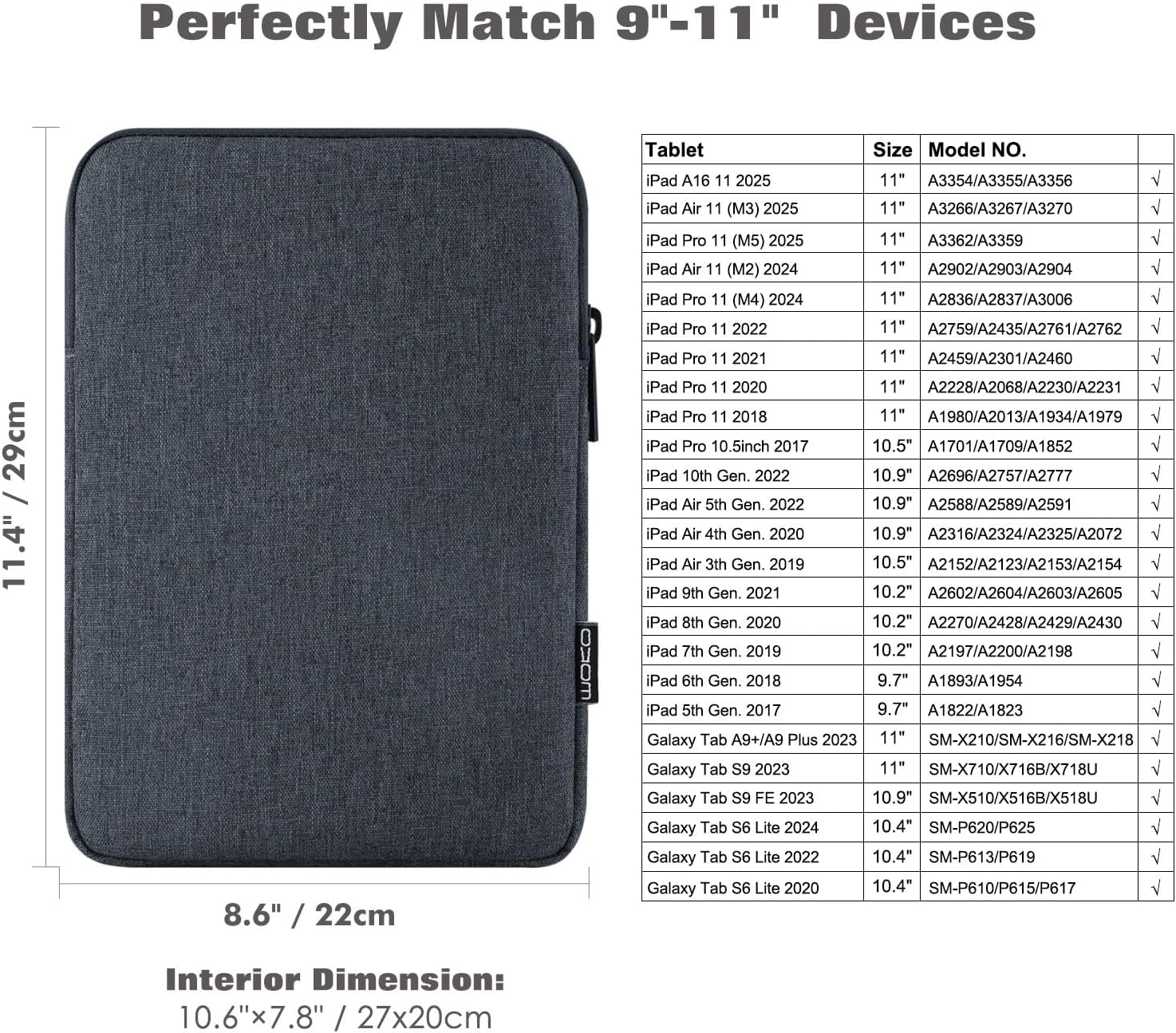
A tablet sleeve is exactly what it sounds like: a snug, padded envelope — usually neoprene, felt, or hardshell fabric — that you slide your tablet into for travel or daily carry. No buckles, no kickstand, just protection and portability. It sounds simple. The problem is that “fits a 12-inch tablet” on an Amazon listing can mean almost anything, and a sleeve that’s even 6 mm too wide will let your iPad Pro rattle around and scratch its own corners on the zipper. Get it right and a $25–$45 sleeve is one of the best-value accessories you can buy. Get it wrong and you’ve got a glorified envelope that offers false confidence. This guide walks through the dimensional math, material tradeoffs, and specific size matches for the most common iPads and Galaxy Tabs in 2026 — so you stop guessing and start buying the right thing the first time.
Why Tablet Sleeves Fail (And It’s Almost Always a Sizing Problem)
Here’s the scenario reviewers at PCMag’s tablet-cases roundup describe over and over: a sleeve listed as “11-inch compatible” arrives and the user discovers it was sized for a bare tablet — not a tablet inside a thin case. That gap matters more than it sounds.
The iPad Pro 11-inch (M4) has physical dimensions of roughly 249.7 × 177.5 × 5.3 mm. Add even a slim 1 mm rubber bumper case and you’re at approximately 252 × 180 × 7 mm. A sleeve sized to 250 × 178 mm won’t zip closed. A sleeve sized to 265 × 192 mm will close fine but lets the tablet slide and lets corner-to-zipper contact happen on every bump.
The right sleeve has roughly 5–8 mm of give on each linear dimension beyond your cased tablet, plus 8–15 mm of padding on each face. That padding thickness — not the total sleeve depth — is what determines drop protection.
By the numbers — common tablet footprints (bare device):
| Device | Dimensions (mm) | What to shop for in a sleeve |
|---|---|---|
| iPad (10th gen) | 248.6 × 179.5 × 7.0 | 11-inch sleeves sized 260–270 × 188–196 mm |
| iPad Pro 11-inch M4 | 249.7 × 177.5 × 5.3 | Same 11-inch bracket; confirm depth accommodates a case |
| iPad Pro 13-inch M4 | 281.0 × 215.0 × 5.1 | 13-inch sleeves; most 12.9-inch legacy sleeves fit with minor snugness |
| Samsung Galaxy Tab S10 Ultra | 326.4 × 208.6 × 5.4 | Needs a dedicated 14.6-inch sleeve; 13-inch sleeves will not close |
| Samsung Galaxy Tab S9 FE | 256.6 × 168.7 × 6.1 | 10.9–11-inch bracket works; shallower than iPad, so padding fill matters |
Sources: device specification pages cross-referenced against TechRadar’s iPad accessories roundup and Android Authority’s Galaxy Tab S10 Ultra accessories guide, both updated through early 2026.
The takeaway: always shop by your device’s actual millimeter footprint, not by the nominal screen diagonal. A “13-inch” sleeve from one brand may be sized for the old iPad Pro 12.9 (280.6 × 214.9 mm) and barely miss the new 13-inch M4’s slightly wider body.
Materials: Neoprene, Felt, and Hardshell — What Each One Actually Does
Once sizing is right, material is the decision that splits the field. There are three practical categories.
Neoprene is the stretchy, wetsuit-like foam-rubber fabric you’ll find in most sleeves under $35. Its strength is conformability — it stretches slightly to accommodate a cased tablet without adding bulk. Owners across aggregated reviews on PCMag and TechRadar consistently note that good neoprene (4–5 mm face thickness) handles the everyday desk-to-bag transfer and the occasional corner bump well. Its weakness: neoprene compresses under sustained pressure, so if your sleeve lives at the bottom of a loaded backpack, it’s not giving your screen meaningful protection against a hard edge. It also attracts lint visibly.
Felt sleeves — typically 3–5 mm pressed wool or polyester felt — are the favorite of the design-professional crowd for one reason: they’re flat. A felt sleeve adds almost no profile to a bag, and the material is naturally anti-scratch against aluminum and glass. Wirecutter’s iPad case methodology notes that felt is particularly well-suited for scratch-only protection when the tablet is carried in a dedicated sleeve pocket (not loose in a main compartment with charger bricks). Against drops, felt is modest at best. It’s the right call for an iPad Pro that lives in a structured bag with its own padded sleeve compartment, not for a commute bag where the sleeve is its own independent armor.
Hardshell fabric sleeves — rigid or semi-rigid polycarbonate shells covered in canvas or ballistic nylon — are the choice when the sleeve itself is the bag. You’re not putting this inside a backpack; you’re carrying it like a clutch with a wrist strap or handle. These run $45–$80 for the quality tier worth recommending, and they genuinely protect against the corner-drop scenario that kills tablet screens. The tradeoff is bulk and the fact that a rigid sleeve is less forgiving about “close enough” sizing — if your tablet-plus-case combination is even 4 mm over, a hardshell won’t accommodate it.
Verdict on materials: Neoprene for daily commuters who already have a structured bag. Felt for creatives with a dedicated sleeve pocket who care about scratch protection and minimal added weight. Hardshell for anyone whose sleeve is the primary carrying solution and who wants real drop confidence.
Size Matching by Device — The Decision Rules
iPad Pro 11-inch M4 and iPad (10th gen)
These two tablets are nearly identical in footprint (within 1.5 mm on the long axis) and share the 11-inch sleeve bracket. The practical difference is thickness: the iPad 10th gen at 7.0 mm is noticeably chunkier than the iPad Pro M4 at 5.3 mm. If you’re running the Pro bare or in an ultra-thin skin, almost any 11-inch neoprene sleeve closes easily. If you’re running the iPad 10th gen in a TPU bumper case, confirm the sleeve’s interior depth spec before buying — some slim-profile sleeves list a maximum depth of 8–9 mm and will struggle.
Shop the 11-inch bracket, interior dimensions roughly 260–270 mm × 188–196 mm, interior depth 10–14 mm. Our recommended material for these devices in a commute workflow: neoprene, 4 mm face padding minimum.
iPad Pro 13-inch M4
This is where legacy-sizing confusion peaks. The old iPad Pro 12.9-inch had a 280.6 × 214.9 mm footprint. The new 13-inch M4 is 281.0 × 215.0 mm — essentially the same. Most “12.9-inch” sleeves made before 2024 will fit the M4 13-inch with only minor snugness. The key watch-out: Apple’s 13-inch Magic Keyboard Folio adds significant thickness. If you’re carrying the iPad in the folio, you are not carrying it in a sleeve — those workflows don’t overlap. Sleeve buyers for the 13-inch Pro are typically carrying the tablet bare or in a slim case, inserting it into the sleeve for transit, and removing it at the desk.
Shop interior dimensions of 290–300 mm × 222–230 mm. Felt or hardshell fabric at this size; neoprene works but look for reinforced zipper construction — the larger perimeter puts more stress on zippers at the corners.
Samsung Galaxy Tab S10 Ultra
This is the problem child of the sleeve category. At 326.4 × 208.6 mm, the Tab S10 Ultra is categorically larger than any iPad and larger than most sleeves listed as “13-inch.” Android Authority’s S10 Ultra accessories guide specifically flags this: the device needs sleeves explicitly spec’d for 14.6-inch tablets, and that category is meaningfully thinner on the market than iPad-focused options. The S Pen garage is on the device body, so you don’t need a sleeve with a stylus loop — but you do need a sleeve whose zipper clear the full 326 mm length without stress.
Owners across review aggregates report that laptop sleeves sized for 13.3-inch ultrabooks (typically 330–335 mm × 215–220 mm interior) are a functional workaround and often better padded than tablet-marketed sleeves — a useful tip if dedicated 14.6-inch tablet sleeves are out of stock or overpriced.
Samsung Galaxy Tab S9 FE and Budget-Tier Tabs
The S9 FE’s 256.6 × 168.7 mm footprint is slightly narrower than a comparable iPad, which means it fits loosely in many 11-inch iPad-targeted sleeves. Loose fit equals rattling and corner contact with zipper hardware. For this device, prioritize sleeves with an internal elastic retention strap or a tighter 11-inch spec (interior width 175–185 mm rather than 188+). The budget stakes here don’t justify a hardshell; a well-reviewed neoprene sleeve in the $18–$28 range is the right call.
Accessory Stack Considerations: When a Sleeve Isn’t Enough
A sleeve becomes insufficient the moment you’re also carrying a keyboard folio, Apple Pencil, or a charging brick as part of a single grab-and-go kit. A sleeve has one job — protecting the tablet — and it does that job when the tablet is in the sleeve. The moment you pull the tablet out to attach the Magic Keyboard Folio, your sleeve is just sitting in the bag doing nothing.
The practitioners who get the most out of sleeves, per TechRadar’s accessories coverage, are people with a deliberate two-mode workflow: sleeve-in-bag for transit, bare-or-folio for the working session. If that’s you, a $25–$40 neoprene or felt sleeve is genuinely one of the cleanest solutions in the accessory stack. If you want a single case that also holds the keyboard, a stylus loop, and a card slot, that’s a folio case, not a sleeve — and the economics and editorial logic are different.
The Decision Rule
If you’re carrying an iPad Pro 11-inch or 13-inch M4 in a structured bag with a dedicated tablet pocket: a felt sleeve, correctly sized, is the right call — minimal weight, maximum scratch protection, clean aesthetic.
If you’re commuting with an iPad 10th gen or Galaxy Tab S9 FE in a general-purpose backpack: neoprene, 4 mm minimum face thickness, correctly sized interior dimensions. Spend $25–$35 and don’t overthink it.
If you own a Galaxy Tab S10 Ultra: shop for a 14.6-inch tablet sleeve explicitly, or use a 13.3-inch ultrabook sleeve as a known-good workaround. Don’t force a 13-inch tablet sleeve and assume it’ll close.
If the sleeve is your only carrying solution (no bag): hardshell fabric, $45–$75, handle or wrist strap included. Everything else will let you down on a drop.
Size first, material second, brand a distant third. The market in 2026 has plenty of well-reviewed options in every bracket — the one that fits your exact device footprint will outperform a premium sleeve that doesn’t.